 Liu Han-Wen
The Fearless King
2026 · Acrylic, Mixed Media on Canvas · 100 × 80 cm · Available
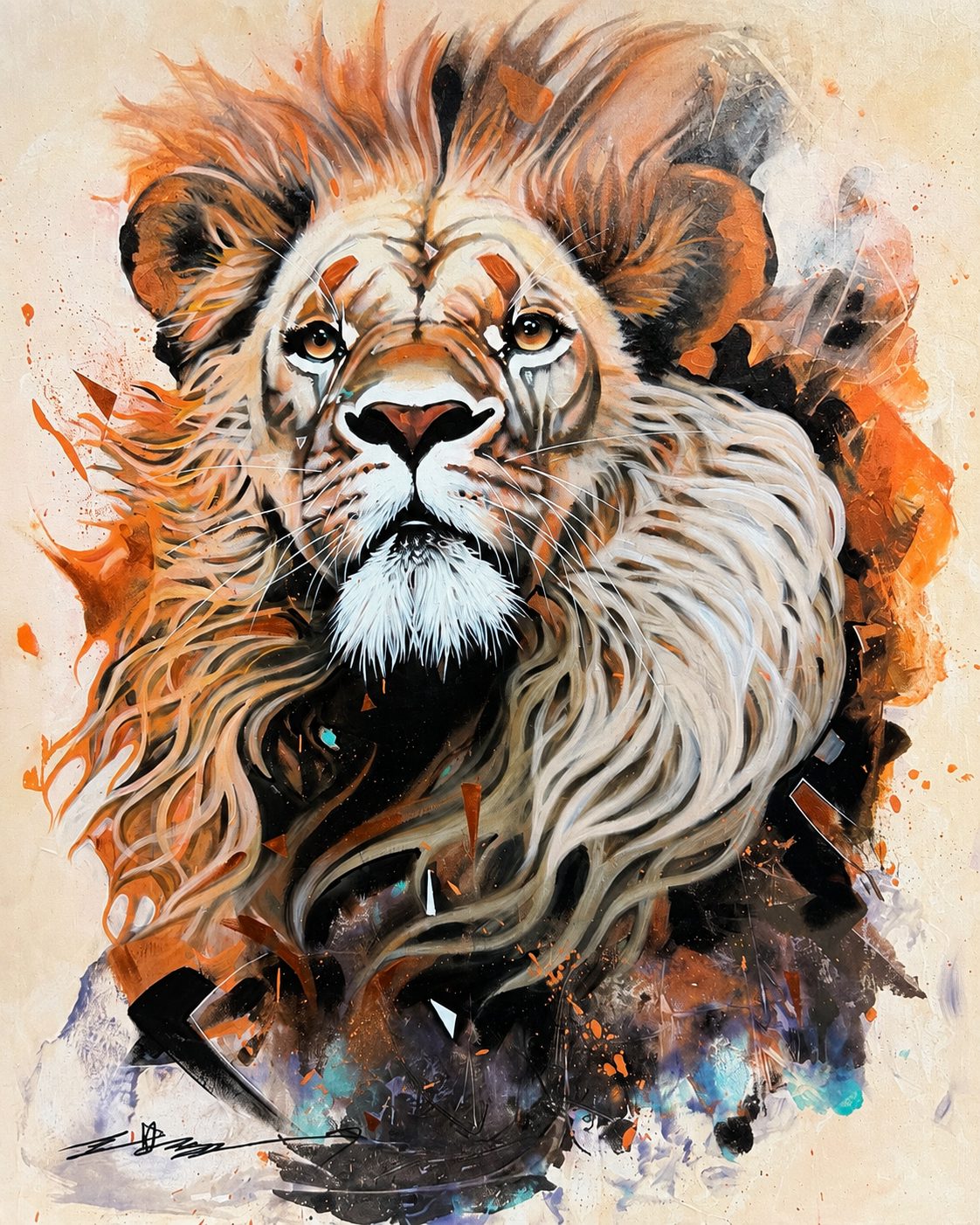
In paintings of animals, the lion has never been merely a creature of the natural world. It carries strength, dignity, courage and the bearing of a king — and with them our own imaginings of freedom, of will, of the force of being alive. The Fearless King (2026), acrylic and mixed media on canvas, 100 × 80 cm, places a single lion facing the viewer. Between saturated colour, unrestrained brushwork and near-abstract construction, it holds a composure that cannot be shaken.
The lion is not described in the traditional realist manner. What the painter keeps is what makes a lion unmistakable — the face, the eyes, the mane — while the body dissolves into blocks of colour, flung marks and geometric fragments. The work therefore stands between figuration and abstraction. From a distance we are caught first by the animal's bearing; up close, the body seems to be forming out of colour and line, and at the same time drifting apart. That unstable edge is what turns the lion from an animal into a state of mind.
What stays with you longest is the eyes.
It does not roar. No bared teeth, no attacking stance. And yet those eyes, looking straight ahead, are the strongest point in the painting. This is not the glare of anger; it is the stillness that follows having been tested. The genuinely strong rarely need to display their strength, because confidence is itself a kind of power. This lion appears to have already walked past fear — which is why the title, The Fearless King, sits so exactly on it.
The colour carries that further. Orange-red, ochre, black and grey-white dominate. Orange runs through mane and background like fire, bringing heat and a sense of eruption; black gives weight and depth, holding the image steady; broad passages of white and pale grey let the mane catch light, so that the animal seems to surface out of chaos.
Note that the mane is not drawn hair by hair. It is built from long flowing curves — like wind, like flame, like energy that will not stay still. What we see is less an animal's coat than a field of life expanding outward from the body.
Below and around the figure, black, orange and blue-green strokes scatter loose against the clarity of the face above. That movement — from clear to broken, from order to freedom — is what makes the picture feel contemporary. It seems to say that life is not tidy or orderly. A life is full of change, collision, loss and rebuilding; what matters is keeping your centre in the middle of all that.
So what The Fearless King really paints may not be the power of a king at all.
It is closer to an inward courage.
To be fearless is not to have never been afraid; it is to see the difficulty and still go forward. Not to have never been wounded, but to keep your dignity after the wound. Not to conquer everyone, but to hold yourself. The lion here is not running and not hunting. It stands quietly — and it is exactly that quiet that makes it impossible to ignore.
The word "king" in the title can therefore be read as a condition of life.
A real king does not necessarily stand at the highest point, nor hold the most power. A real king is the one who keeps direction while everything outside is shifting, who keeps judgement under pressure, who still trusts himself in solitude. The lion is only the form the painter chose; the spirit it carries can belong to anyone facing something difficult.
The Fearless King joins the force of an animal to the free language of contemporary painting. The realism of the gaze makes an emotional connection; the abstraction of colour and mark leaves room for imagination. It is decorative in the strongest sense, and it holds up to being looked at again and again.
Standing in front of it, what we finally see may no longer be a lion.
We see courage, dignity, and a life that has been through weather and is still looking forward.
Fearless does not mean without fear; a king does not mean conquering the world. The truly fearless king is the one who, in any circumstance, has not lost himself.